By Caitlin Stamatis, PhD
I'm going to say something that might get me in trouble on the internet: your ex is probably not a narcissist.
I know. I know! But hear me out — because I say this as someone who has diagnosed actual narcissistic personality disorder in clinical settings, who has sat across from people experiencing real harm from partners with genuine narcissistic traits, and who has also, I'll admit, texted a friend "omg he's such a narcissist" about a guy who simply didn't text back fast enough.
We've all done it. Therapy-speak has become the lingua franca of modern relationships. Labeling someone a narcissist or declaring your mother-in-law "emotionally unavailable" gives you a framework. It feels like clarity, like you've figured something out.
I've been noticing something, though — both as a psychologist and as someone who spends her days looking at (okay, obsessing over) how people actually talk about their emotions — that complicates this story in a way I think is worth sitting with.
What 2,000 conversations tell us
At Ash, I recently analyzed over 2,000 conversations where users brought up psychological terminology — words like "narcissist," "boundaries," "gaslighting," "avoidant attachment," "toxic." The language of TherapyTok.
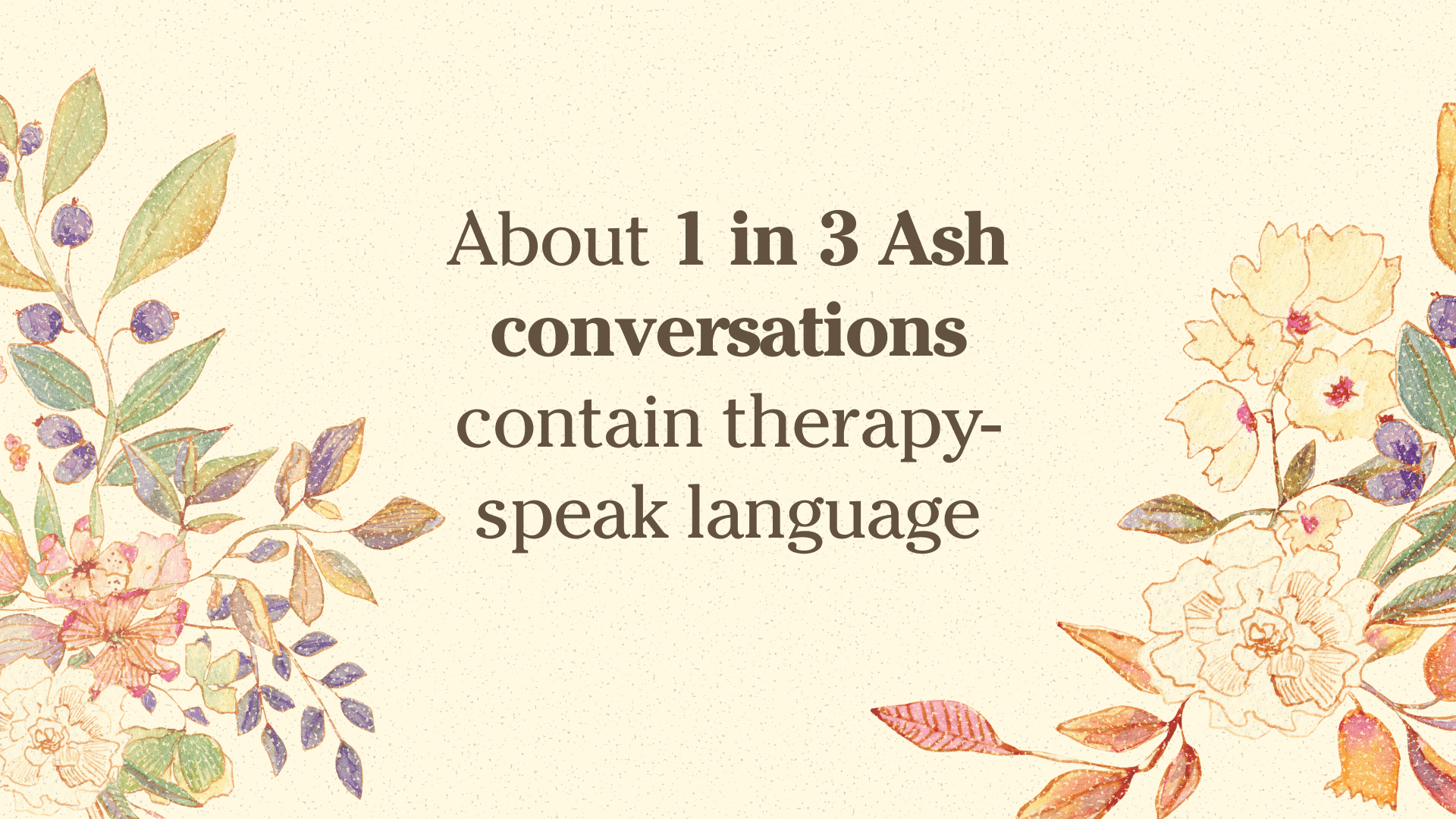
About a third of all conversations with Ash contain some form of therapy-speak. That tracks with what researchers have been observing at the cultural level — terms like "boundaries," "gaslighting," and "narcissist" have migrated into everyday language at a pace that's hard to overstate, especially on social media and especially since the pandemic. But what surprised me was how people were actually using these terms with Ash.
The most common way wasn't diagnosing someone else — it was self-labeling. More than half the time, people weren't saying "my partner is a narcissist." They were asking things like: Am I the toxic one? Am I too codependent? Is this my anxious attachment showing up?
And here's the part that really got me: "narcissist" — the term the internet will not shut up about — appeared in less than 1% of conversations. Less than "situationship." Less than "enmeshment" (really, enmeshment?). The word that dominates our cultural discourse about relationships is almost entirely absent when people actually sit down to work through what they're feeling.
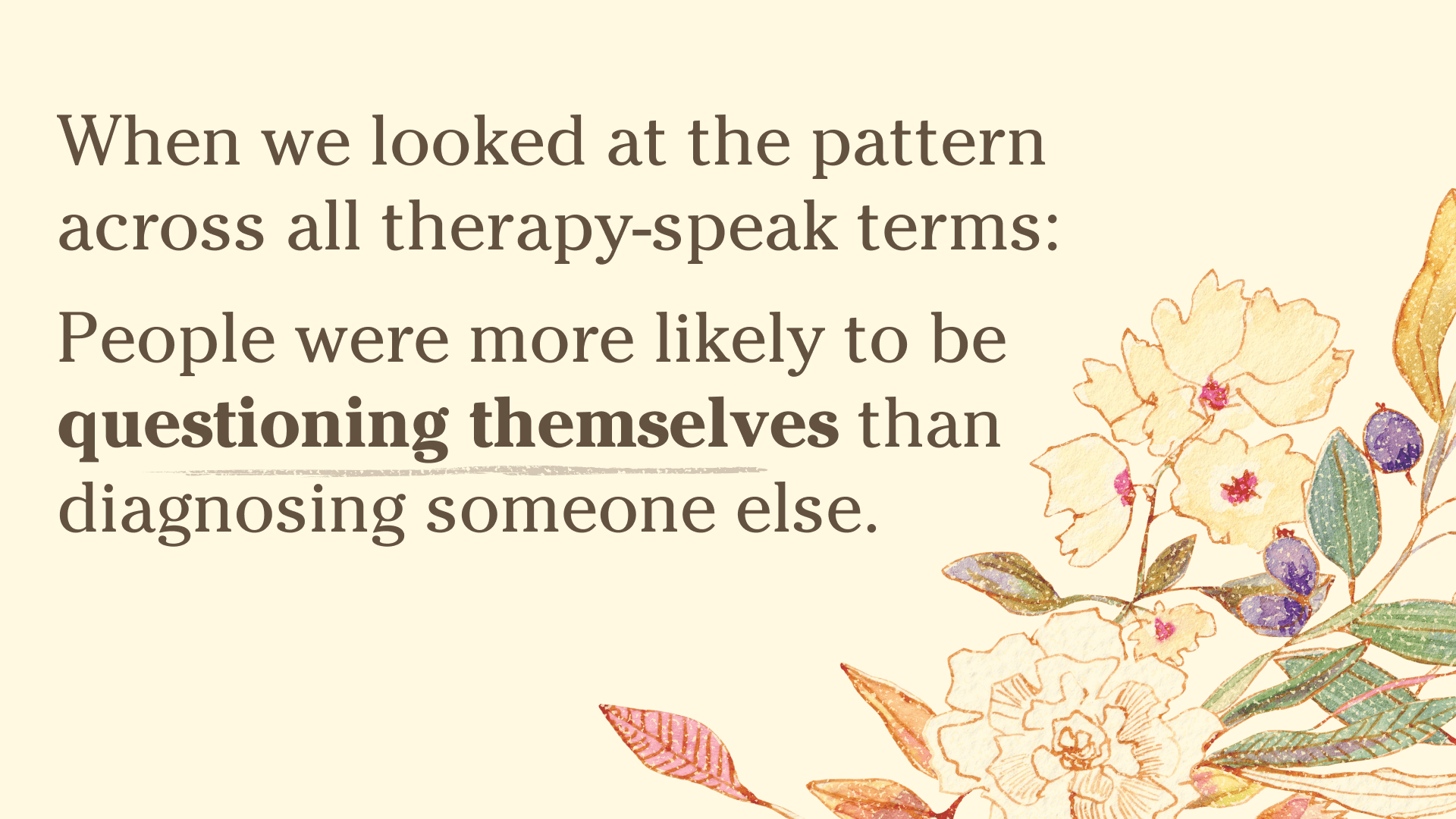
What does show up is more revealing. "Boundaries" appeared in over 11% of sessions. "People-pleasing" in nearly 6%. "Emotionally unavailable" in almost 8%. Not every term works the same way — someone wondering "am I people-pleasing?" is of course quite different from someone declaring their partner "emotionally unavailable." But when we looked at the overall pattern across all therapy-speak terms, the same thing kept showing up: people were more likely to be questioning themselves than diagnosing someone else.
The gap between the feed and the feelings
There's this gap between the content people consume and what they actually bring to the table when they sit down to process something real. My feed is full of "5 Signs Your Partner Is a Covert Narcissist" and "How to Tell If You're Being Gaslit" — and the implicit message is always that the problem is the other person, and here's the clinical term for what's wrong with them.
When people go somewhere private to actually work through what's happening in their lives, though — at least in what we see with Ash — the questions they're bringing are mostly about themselves. I find that kind of moving, and also a little heartbreaking, because the impulse to self-label ("am I a narcissist?" "am I avoidant?") often comes from the same place as labeling someone else. You're trying to take something confusing and painful and make it make sense. You're reaching for the closest word that might explain why things feel the way they do.
And that impulse makes total sense! Mental health language has always seeped into how we talk; social media has just massively amplified it. As a therapist, I'm glad people have the vocabulary. What worries me is that a label — whether you pin it on your ex or yourself — can shut down the curiosity it was supposed to open up.
Why "narcissist" almost never means narcissist
Clinical reality check. Narcissistic personality disorder is estimated to affect roughly 1-2% of the general population. It's a real diagnosis with real consequences for the people around it — and also not what's happening every time someone is selfish or avoidant or bad at texting.
What I think is actually going on — and this is my thinking-out-loud, not-peer-reviewed take — is that people have absorbed the vocabulary of therapy without absorbing the process. And that's not our fault. TikTok is genuinely great at distributing terminology and genuinely terrible at distributing nuance. When researchers analyzed 1,000 mental health videos on TikTok across multiple languages and countries, they found that videos about personality disorders were among the most likely to contain disinformation — with content that was inaccurate, oversimplified, or outright stigmatizing. You can learn the word "narcissist" in 30 seconds. Understanding what it actually means — clinically, interpersonally, and in the context of your specific relationship — takes a lot longer.
If this sounds familiar, it's basically med student syndrome for the TikTok era — that well-documented phenomenon where first-year medical students become convinced they have every disease they're studying. Academics have even rebranded this tension as "prevalence inflation hypothesis": mental health awareness efforts, while genuinely important, can also lead people to over-pathologize common emotional experiences. You learn the vocabulary of disorder and start seeing it everywhere, including in yourself. None of this is to say awareness is bad (it obviously isn't), but the oversimplified version of it can make things harder when you're trying to understand what you're actually feeling.
What happens when the label becomes the endpoint
Here's the thing I wish I could go back and tell every client I've ever worked with — and honestly, myself: when you decide your ex is a narcissist, you get a clean explanation for something messy. A villain, a victim, a story that makes sense. And you also get to stop asking the harder questions — what was I feeling in that relationship? What did I need that I wasn't getting? What keeps showing up for me?
In clinical psych, there's a useful distinction between insight and intellectualization. Insight is when you understand something about yourself and it actually changes how you move through the world. Intellectualization is when you use the language of understanding as a way to avoid feeling the thing. Therapy-speak can go either direction, and I think a lot of us (myself included) don't always know which one we're doing in the moment.
The person who's wondering whether their boyfriend's behavior can be attributed to "avoidant attachment" might actually be trying to say something much simpler: I feel like I care more than he does and I don't know what to do with that. And the person asking Chat "am I a narcissist" at 2am is probably not a narcissist — people with NPD are not, as a loose rule, the ones lying awake worried about it. They might really just be saying: I did something selfish and I'm scared of what that means about me. Those feelings deserve more room than a label or diagnosis can give them.
What I'd want you to take away from this
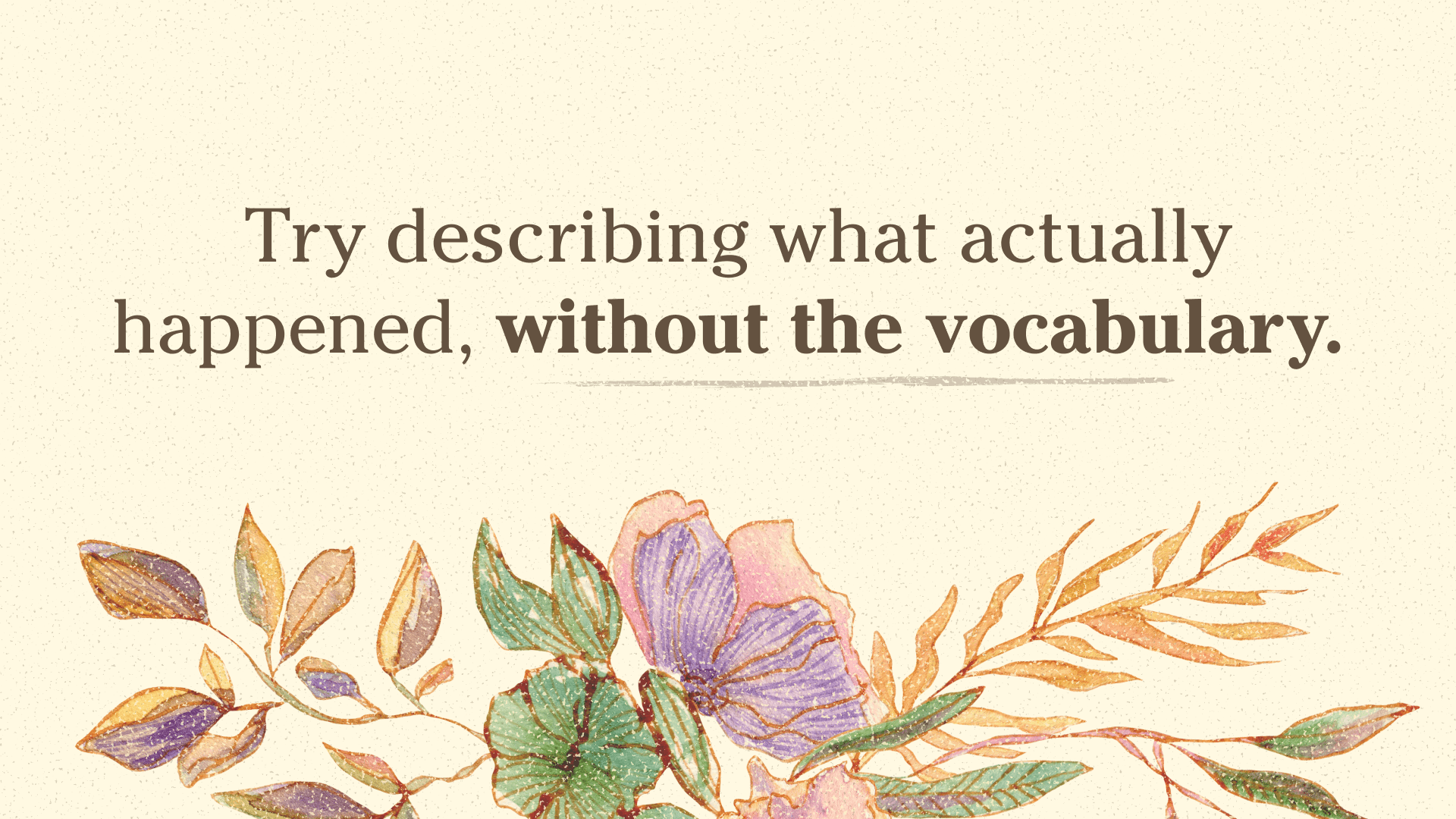
I'm not going to give you a five-step framework for deconstructing therapy-speak (though I'm sure someone on TikTok has that covered). What I will say is: next time you catch yourself reaching for a clinical term to explain someone's behavior — or your own — try describing what actually happened, without the vocabulary. Not "he's gaslighting me" but "I told him how I felt and he said I was overreacting, and now I don't trust my own read on it, but I also feel really hurt." Not "I'm anxiously attached" but "I keep checking my phone and I hate that I care this much."
The second version is always messier and always closer to the truth, and it tends to point you toward what you actually need, which (in those moments) is rarely a diagnosis.
Maybe the problem isn't that we're using the wrong words. Maybe it's that we're reaching for words too quickly — before we've actually sat with what happened, how it made us feel, what we're afraid it means. You have a fight with your partner and within ten minutes you're searching "avoidant attachment style signs" instead of just letting yourself feel the hurt for a second.
I think what most people need isn't a diagnosis for the person who hurt them or a label for what's wrong with themselves. It's something much quieter than that — a way to pause, to understand what's actually going on in their life, and to figure out what they want to do about it. That's harder than a label. It's also the thing that actually helps.
Caitlin Stamatis, PhD, is Head of Research at Ash by Slingshot AI. She's a clinical psychologist, digital health scientist, and someone who has definitely used the word "toxic" to describe a coworker she simply didn't like. Data in this post are based on an analysis of 2,059 anonymized Ash conversations.
